
Like most people of my generation, I run to my friend, Google, when faced with a serious dilemma. And this is what came up first when I typed in, “What is a midlife crisis?”
Midlife Crisis [noun]”a loss of self-confidence and feeling of anxiety or disappointment that can occur in early middle age.”
The definition above may be a popular one but it definitely doesn’t cover it. There are entire websites, a well-referenced Wikipedia page, numerous articles, and even a song on the topic. To save you some time, I went through a lot of the good, bad, and ugly on the Internet and put together a few of the essentials to get you started:
1. Women can have their midlife crisis earlier than men. For women, it can happen between the ages of 35-44. What’s more, women have their midlife crisis for different reasons and it can manifest in a way that is different from men. Women face a unique set of challenges which often includes unequal pay, the proverbial glass ceiling, and greater responsibility for childcare and care of aging parents. At some point, they begin to question why they work so hard for measly returns and in the end, some simply want to stop trying. I don’t blame them!
2. When exactly is midlife? High-schoolers think that 35 is middle-aged while 35 year-olds balk at this idea. Two serious scholars asked a bunch of Swiss citizens and they seem to have settled on the age group 35-53. Other articles put it at an age range of 40-65, a point where many have achieved sufficient security and are thinking about their mortality. I’m targeting this blog to the 40-60 age group as a compromise.
3. ‘Midlife crisis’ is real but for most people midlife is actually a happy time. There is an ongoing debate on whether or not ‘midlife crisis’ exists at all. Freudians coined the term to describe those of us who are getting older and more aware of our own mortality, often resulting in a wild panic and an attempt at recovering one’s youth (think 20 year old lover or botox or both). Recent research however shows that more people are actually fulfilled at midlife (graph below is from a WSJ article). The ones that do go through a real ‘crisis’ are in the minority.
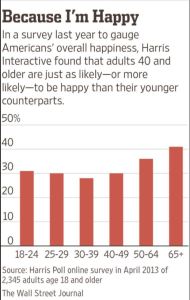
Both sides of the debate appear to agree though, that while the word ‘crisis’ is debatable, there is a transition that happens midlife. At this age, people go through similar experiences such as the loss of a parent, narrowing work options, and well, backache.
My non-expert conclusion: The problem is real. Crisis is subjective and for the purpose of this blog, ”midlife crisis” is equal to ‘transition’.
4. A midlife ‘crisis’ is not necessarily negative. The words “midlife” and “crisis” put together are often associated in popular media with divorce, financial woes, and an awkward old man with a flashy car. This could well be the way it manifests for some but I like to think that a midlife crisis is primarily about a person questioning his or her purpose at life’s midpoint. In my opinion, trying to understand how to make the most of one’s remaining days is not a bad thing. It can lead to a productive change in career, a healthier lifestyle, or even a positive shift in priorities from work to family.
5. Whatever your situation, it’s best to reach out for help. There is a reason why we look up old friends at midlife; we don’t want to go through this transition alone! The common thread among the articles I’ve read is that it is best to accept that one is getting old and find friends going through the same experience. Judging by the anecdotal evidence the Internet offers – a highly scientific process of course 😉 – denying one’s circumstances by trying to recapture one’s youth is likely to end in disaster. So before you go out and buy that Porsche, have a drink with an old friend instead. That might be a cheaper solution to the problem.
Source articles: Emling, Shelley (2013) “Seven signs you may be having a midlife crisis” Huffpost (link) / Reynolds, Marcia (2011) “What a female midlife crisis looks like” Psychology Today (link) / Bering in Mind Blog “Half Dead: Men and the Midlife Crisis” (link) / Rauch, Jonathan (2014) “The Real Roots of Midlife Crisis”, The Atlantic (link) / Almeida, David (2009) Ask the Brains: Is the Midlife Crisis a Myth (link). / Tergesen, Anne (2014) “The Myth of the Midlife Crisis” Wall Street Journal (link) / Freund and Ritter (2009) Midlife Crisis: A Debate, Gerontology (link)
 Midlife Space
4 Replies to “Midlife: what you need to know”